RAG Chatbot vs Autonomous AI Agent for Support Teams

TL;DR
RAG is an answering method; autonomy is a level of decision-making and action.
Most repetitive support questions need accurate retrieval, citations and escalation not unrestricted autonomy.
Matram is built around answers grounded in your content, source links, strict mode and human handoff.
Add action-taking only when the task has clear permissions, success checks and a safe recovery path.
Short answer: A RAG chatbot retrieves information from approved sources to answer a customer’s question. An autonomous AI agent can choose tools and perform actions such as looking up an order, changing a record or issuing a refund. They are not competing technologies: an autonomous agent can use RAG. For most support teams, the sensible starting point is a grounded system such as Matram for documented questions, with controlled workflows and human handoff for anything that changes customer data.
A customer asks, “Does the Standard plan include the public API?” The useful support system finds the pricing page, answers and shows the source.
Now change the request: “Move me to the Standard plan and send the new invoice.” The system must identify the customer, check permissions, update billing and confirm the result. That is no longer an information-retrieval problem. It is an action with financial and account consequences.
This is the real distinction when comparing a RAG chatbot vs AI agent: does the customer need a supported answer or a change inside another system?
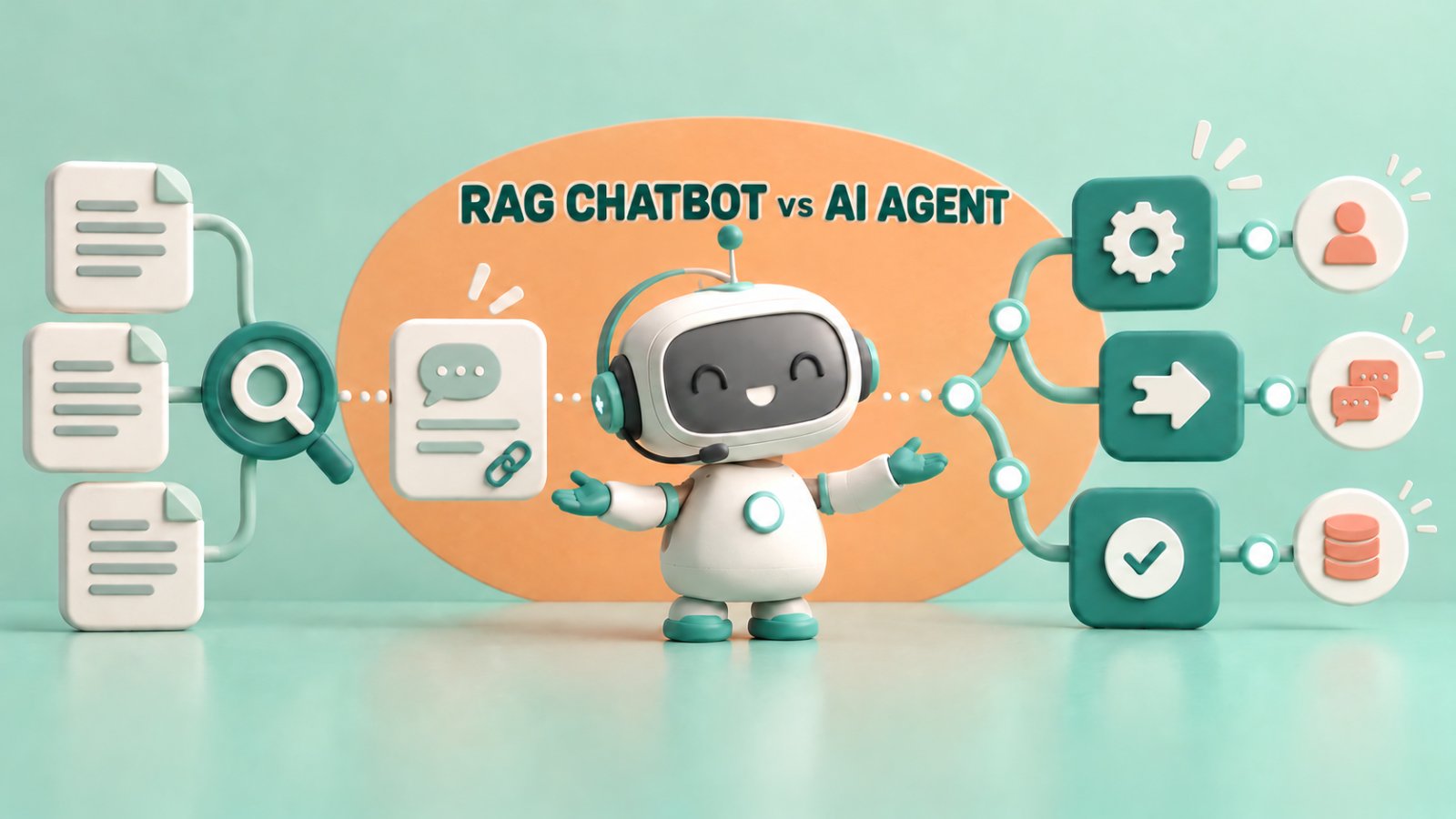
RAG chatbot vs AI agent: the difference in one table
RAG stands for retrieval-augmented generation. The original RAG research paper described a system that combines a language model’s learned knowledge with retrieved information from an external index. In customer support, that external information is usually your website, help centre, product documentation or uploaded files.
An autonomous agent goes further. It can decide how to complete a goal, choose among permitted tools, review the result and continue until it reaches a stopping condition or needs human input.
| Difference | RAG chatbot | Autonomous AI agent |
|---|---|---|
| Primary job | Find relevant information and answer | Complete a goal through multiple decisions or actions |
| Main inputs | Approved pages, documents and knowledge bases | Instructions, live system data, tools, APIs and feedback from previous steps |
| Typical support task | Explain a policy or troubleshoot from documentation | Look up an account, change a booking or process an approved action |
| Control model | Bounded by connected knowledge and response rules | Chooses a path dynamically within its permissions\ |
| Main risk | Retrieving the wrong, incomplete or outdated passage | Taking the wrong action or allowing errors to compound across steps |
| Best safeguard\ | Current sources, citations, strict answering and handoff | Narrow permissions, identity checks, approval gates, logs and rollback paths |
The categories can work together. An autonomous support agent may use RAG to read a refund policy before deciding whether a refund request can proceed. RAG supplies the evidence; the agent decides and acts.
How a Matram RAG chatbot answers support questions
Matram starts with information your business controls. You connect relevant website pages, help content and files. When a visitor asks a question, Matram retrieves matching passages instead of asking the model to answer from general memory alone. The flow is straightforward:
- A visitor asks a question on the website or another supported channel.
- Matram searches the connected content for relevant passages.
- The model writes an answer using that retrieved material.
- The response cites its source so the visitor can verify it.
- If the content does not support an answer, strict mode can keep the agent from filling the gap and offer a route to a person.
The strength of this model is control. A product question should use product documentation; a cancellation question should use the current policy. If neither source contains the answer, a confident guess is not useful support.
RAG does not make weak content reliable. Contradictory pages and outdated help articles can still produce poor answers, so a content owner must remove conflicts, publish updates and review unanswered questions.
Matram’s chatbot best-practices guide covers the testing and content maintenance that should happen around the technology.
What an autonomous support agent adds
An autonomous agent adds tools and model-directed decision-making. Instead of following only a fixed answer flow, it can inspect the situation and decide what to do next.
Suppose a customer says, “My package was due yesterday. Find out what happened and arrange a replacement if it is lost.” An action-taking agent may need to verify identity, retrieve the correct order, check the carrier, apply the replacement policy, create the replacement and update the ticket.
That flexibility is valuable, but every additional tool expands the failure surface. The agent can choose the wrong order, misunderstand an exception, call a tool with incorrect information or continue after an earlier step failed.
Anthropic’s engineering guidance on agents separates workflows, which follow predefined paths, from agents, which dynamically direct their own process and tool use. It also recommends starting with the simplest workable approach because agentic systems can trade additional cost and latency for flexibility and may compound errors across steps.
“More autonomous” is not automatically “better.” Autonomy is justified when the work requires variable steps and the outcome can be checked. It is unnecessary when the customer only needs an accurate answer.
Which support questions need RAG and which need action?
The cleanest test is to ask what must be different after the conversation.
If the customer only needs to understand something, RAG is usually the right foundation: “Which plan includes this feature?”, “How do I reset this device?” or “Does your product integrate with our stack?”
Matram can answer these questions from the business’s connected content and show the supporting page. The same grounded approach can handle follow-up questions and respond in more than 95 languages, although important terminology and high-risk answers should still be tested.
If the customer needs the business to change something, retrieval alone is not enough. Cancelling an account, issuing a refund, rescheduling an appointment or updating a CRM requires authorised access to another system.
Matram can still answer the documented part of the request, capture the relevant details and hand the conversation to a person with context. Where a defined integration or workflow is available, a controlled automation can handle the permitted step. That is different from giving a model broad access and asking it to work out every action for itself.
For more examples of where answering ends and action begins, see Matram’s guide to AI agents vs chatbots.
Why most support teams should begin with grounded answers
Support queues contain repeated questions about prices, policies, setup, compatibility and known problems. These questions do not become more valuable when an autonomous system handles them. They become useful when the answer is quick, correct and verifiable.
Starting with Matram gives the team a bounded first layer. It answers documented questions, cites the source, captures an enquiry and passes unsupported or sensitive cases to a person. Conversation history and unanswered questions also expose content gaps.
Humans remain responsible where judgement matters: unusual refunds, sensitive complaints and contradictory account information. The AI handles approved knowledge; the person owns the exception. Evaluation is direct: confirm that the cited page supports the answer, unsupported questions are escalated and the transcript follows the handoff.
Matram’s guide to choosing the best customer service chatbot explains why answer quality, handoff and billing structure are more useful buying criteria than a long feature list.
When an autonomous agent is worth the added complexity
Autonomy becomes reasonable when all four conditions are true:
- The task cannot be reduced to an answer or predictable workflow. The correct steps change with the customer’s situation.
- The agent has the live data and tools required to finish. Access to a knowledge base alone will not update an order or account.
- Permissions can be kept narrow. A returns agent should not have unrestricted access to billing, identity and customer records.
- The result can be verified and recovered. The system needs logs, success checks, stopping conditions and a clear route to a person.
High-impact actions may need approval gates. An agent could prepare a refund while a person confirms it above a defined amount. Automate only the parts where the business can define acceptable behaviour and detect failure.
If these controls are not available, Matram’s grounded answer-and-handoff model is the safer operational choice. The customer still gets immediate help, and the consequential action stays with an accountable team member.
How to choose between a RAG chatbot and an AI agent
Review a month of real conversations and label each one:
- Answer: resolved using approved public information.
- Clarify: needs one or two questions before the correct information can be found.
- Handoff: needs judgement, private data or an exception.
- Action: requires a change in another system.
If most conversations sit in the first two groups, start with Matram. Connect the right sources, enable strict boundaries, define handoff triggers and test real customer wording.
If a meaningful share sits in the action group, list the exact systems, permissions and failure consequences involved. Do not buy “autonomy” as a general capability. Define one action at a time, decide how success will be checked and determine when a person must approve it.
The result may be a layered system: Matram answers from approved content, a controlled workflow handles a narrow action where supported, and a person receives everything else. It is easier to test, explain and trust than a promise of fully autonomous support.
Frequently asked questions
Is a RAG chatbot an AI agent?
It can be marketed as one, but RAG alone does not make a system autonomous. RAG retrieves relevant information for the model. An autonomous agent also decides which actions or tools to use and can adapt its path based on the results.
Does RAG eliminate hallucinations?
No. It can retrieve the wrong passage, misread it or use outdated content. Citations, strict rules, testing and handoff reduce the risk without eliminating it.
Is Matram a RAG chatbot or an autonomous AI agent?
Matram’s core support capability is RAG-based: it answers from connected business content and cites the source. It also supports controlled outcomes such as lead capture and human handoff. It is not designed to give a model unrestricted access to every business tool.
Start with the support job, not the label
The choice is not between old and new technology. It is between answering and acting, and support teams may need both at different moments.
Matram provides grounded answers from your content, visible source citations, strict boundaries, lead capture, and a clear route to a person. This handles repeated questions without exposing business systems to unnecessary autonomy.
Test Matram against last month’s real customer questions. Check the citations, include questions your content cannot answer, and inspect the human handoff. If the remaining work requires changes inside other systems, automate those actions separately using narrow permissions and measurable success conditions.
See Matram in action
Watch it answer from real content, with the exact source page cited, on the live demo.
Book a demo